

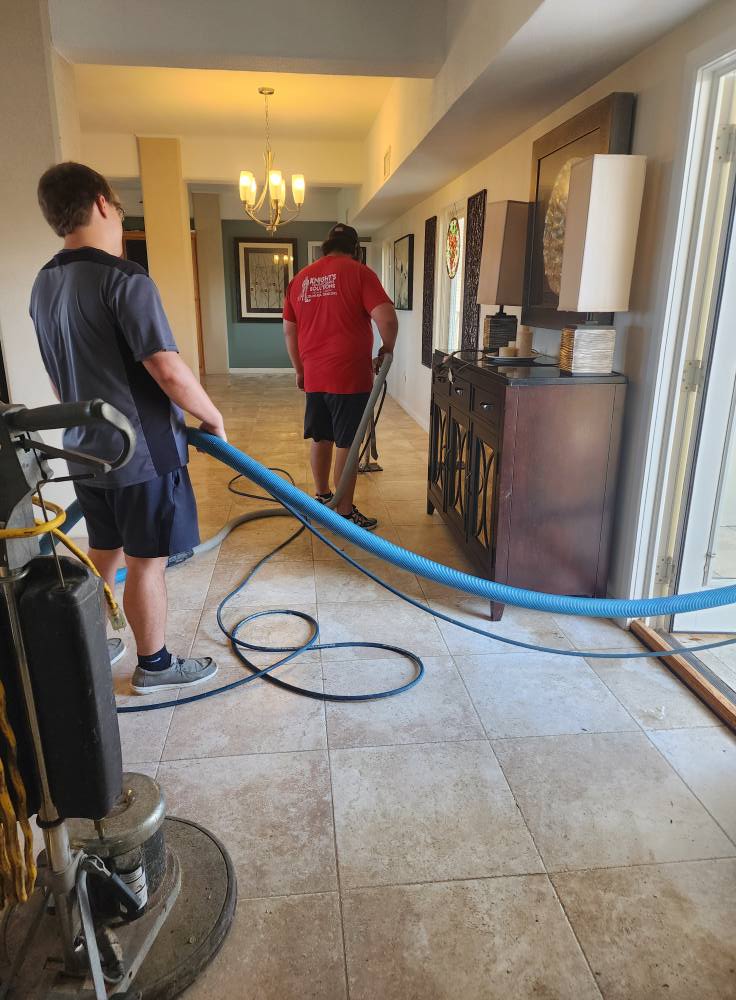
You just finished mopping, and instead of a clean shine, your tile looks dull, streaky, or covered in a hazy film. If that’s happening every time you mop, you’re not doing anything wrong – you’re running into one of five common causes, and every one of them is fixable.
At Knight’s Coastal Cleaning Solutions, we’ve been cleaning tile and grout across the Mississippi Gulf Coast – Pascagoula, Gulfport, Biloxi, Ocean Springs, Gautier, and Mobile, AL for over 7 years. Cloudy tile is one of the most common calls we get, and it’s rarely a sign your floor is damaged.
Here’s exactly what’s causing it and how to clear it up, including when it’s worth calling in a professional instead of fighting it yourself.
What's Actually Causing the Cloudy Film on Tile Floors?
1. Cleaner residue
Most bottled floor cleaners contain surfactants that lift dirt but don’t fully rinse away on their own. Use too much, or skip the rinse step, and that residue dries into a thin film that catches the light which reads as “cloudy” even on a floor that’s technically clean.
Fix: Dilute cleaner exactly to label instructions, and skip “multi-surface” sprays unless they’re labeled safe for sealed tile and grout.
2. Not rinsing after cleaning
This is the single biggest cause we see on service calls. Mopping with a cleaning solution and stopping there, without a clean-water pass afterward – leaves dissolved residue to dry right on the surface.
Fix: After mopping with any solution, go over the floor again with a mop dipped only in clean, warm water.
3. Hard water deposits
Much of the Mississippi Gulf Coast draws water from groundwater and limestone aquifers, and homes here commonly deal with hard water. As that water evaporates off tile, it leaves behind calcium and magnesium minerals – a chalky, whitish haze that’s most visible on darker tile.
Fix: Dry floors immediately after mopping with a microfiber towel, or mop with distilled water if hard water is a known issue in your home.
4. Reusing dirty mop water
Every time you dip the mop back into water that’s already picked up dirt, you’re redepositing grime instead of removing it and it dries as a dull, uneven film.
Fix: Change mop water every 150–200 sq. ft., and rinse the mop head frequently. Microfiber traps dirt far better than string or sponge mops.
5. Grout haze from new tile or grouting
If your tile was installed or regrouted recently, that foggy film is likely leftover grout haze – fine particles that dried onto the tile surface during the job. Regular mopping won’t touch it; it needs either a grout-haze-specific cleaner or professional extraction.
How to Clean Cloudy Tile Floors Yourself
- Sweep or vacuum first. Skipping this step is what turns mopping into “wet sweeping” – dirt just mixes into the water and streaks as it dries.
- Use a tile-appropriate cleaner, matched to your floor type (ceramic, porcelain, or natural stone). Skip anything promising extra “shine” – those almost always leave residue behind.
- DIY option: mix 1 gallon warm water with 1 cup white vinegar. It cuts through film without leaving its own residue. (Skip vinegar on natural stone like marble or travertine – it can etch the surface.)
- Mop with a damp – not soaked – mop, rinsing it out often.
- Rinse with clean water in a second pass. This step alone eliminates most cloudy-floor complaints.
- Dry completely with a clean microfiber towel or dry mop. Water sitting and air-drying is what actually creates most mineral spotting.
When the Haze Won't Come Off
If you’ve rinsed, dried, and it’s still hazy, you’re likely dealing with buildup that’s gone past what a mop can fix:
- Vinegar rinse (stronger): 1 part white vinegar to 4 parts water, mop, then rinse clean. Good for light haze and hard water film.
- Baking soda paste: for heavier buildup, apply a paste to a small test area, scrub gently, rinse.
- Call a professional: If DIY methods haven’t worked after one or two attempts, you’re dealing with sealed-in residue, grout haze, or mineral buildup that’s bonded to the surface – at that point, scrubbing harder just risks dulling the glaze.
DIY vs. Professional Tile Cleaning - How to Know Which You Need
| DIY mop-and-rinse | Professional tile cleaning service | |
|---|---|---|
| Best for | Light film, occasional haze | Recurring haze, grout haze, years of buildup |
| Tools | Mop, vinegar, elbow grease | Low-moisture extraction, pH-balanced solutions, pressure equipment |
| Risk | Can dull glaze if over-scrubbed or wrong chemical used | None – matched to your tile type |
| Result | Temporary improvement | Full residue removal, restored shine, protected seal |
If you’ve tried the steps above and the cloudiness comes right back within a week or two, that’s the clearest sign the buildup is below the surface – mopping harder won’t fix it, but a professional tile cleaning service will.
How to Keep Tile From Clouding Up Again
- Sweep or vacuum before every mop
- Use the correct cleaner dilution – more isn’t better
- Always rinse with clean water after cleaning
- Dry floors after mopping, especially in hard-water homes
- Swap in a microfiber mop head if you’re still using string or sponge
- Book a professional tile and grout cleaning roughly twice a year to clear what routine mopping can’t reach
What is the cloudy residue on my tiles?
Usually leftover cleaner or hard water mineral deposits. If your tile was recently installed or regrouted, it’s often grout haze instead.
How can I remove haze from tile floors after cleaning?
Try a 1:4 vinegar-water rinse first. If that doesn’t clear it after a couple of attempts, the residue is likely bonded below what mopping can reach – that’s when a professional tile and grout cleaning saves you time and protects the glaze.
How do you make tile floors shine after mopping?
Rinse with clean water, dry the surface fully, and use a cleaner made specifically for tile. Skip wax-based or oil soaps – they build up residue over time.
Is vinegar safe for all tile types?
It’s safe for ceramic and porcelain, but avoid it on natural stone like marble or travertine – the acid can etch the surface.
Why does my floor still look cloudy even after I rinse it?
If rinsing doesn’t clear it, the haze is likely older buildup – hard water scale, old grout haze, or residue that’s been drying in layers for months. That’s below what a standard mop-and-rinse can remove, and it’s the point where professional extraction cleaning makes sense.
Still Cloudy? Let's Fix It for Good
If your tile still looks dull after trying all of this, or the haze keeps coming back no matter how carefully you mop, it’s usually buildup that’s gone below the surface – and that’s exactly what our equipment is built for.
Knight’s Coastal Cleaning Solutions has been restoring tile and grout across Pascagoula, Gulfport, Biloxi, Ocean Springs, Gautier, and Mobile, AL for over 7 years. We use low-moisture extraction and pH-balanced, residue-free solutions that lift embedded buildup without damaging your tile’s glaze or sealant – something a mop simply can’t do.
Book your free tile & grout inspection today Or call us directly at (228) 249-9334. Licensed, insured, and backed by a 100% satisfaction guarantee.